TECT Community Trust (TECT) is highlighting the impact of its ongoing support for conservation across the Western Bay of Plenty this Conservation Week, recognising the people and organisations working to protect our natural environment and taonga species.
TECT has supported Bay Conservation Alliance (BCA) since 2018, recognising early on that protecting the Western Bay of Plenty’s natural environment takes more than passionate volunteers. It also takes strong coordination, shared capability, and a lead organisation that can support local groups to thrive.
Bay Conservation Alliance exists to support and enhance the capability and impact of community and partner organisations working to restore and protect the natural environment. It does this by connecting projects and building strong networks across the region. It also provides shared support services that lighten the load for volunteer‑led groups, including administration, financial systems, marketing and communications support, policy and health and safety guidance, technical advice, and training and networking.
TECT’s Community Impact Manager Paula Hudson says supporting conservation aligns closely with TECT’s strategic focus area of the natural environment.
“TECT supports conservation because a healthy natural environment is fundamental to the wellbeing of our communities,” says Paula. “By investing in organisations like BCA, we’re backing both the environmental outcomes and the people who make this work happen.”
When TECT first began funding Bay Conservation Alliance, the focus was on strengthening BCA’s ability to support both itself and its local member groups through a mix of operating support, project costs and equipment.
“This model makes it easier for smaller organisations to focus on hands‑on conservation work, rather than being weighed down by back‑end administration,” says Paula.
Since those early days, Bay Conservation Alliance has grown significantly, from 11 member organisations in 2019 to now supporting 38 member groups across the Bay of Plenty, including 24 within TECT’s district, reflecting both growth and increasing regional reach.
Feedback from across BCA’s network highlights the value of this approach, with member groups describing how access to shared support has helped lift their capability and reduce the burden of back‑end work, allowing more time and energy to be directed toward conservation outcomes.
“This is what a strong lead body does well,” says Paula. “It builds confidence, capability and connection across a whole sector, so community groups aren’t each trying to solve the same problems alone.”
In September 2025, TECT made its most significant commitment to strengthening conservation leadership and capacity in the Western Bay by approving $1.5 million over three years for Bay Conservation Alliance through TECT’s Catalyst for Change Fund.
Alongside this investment, TECT also approved $311,268 over two years to 10 of BCA’s member groups in the Western Bay, supporting operating costs and key equipment that help keep on‑the‑ground conservation work moving. This funding was granted to Aongatete Forest Project, ARRC Wildlife Trust, Friends of the Blade, Maketu Ongatoro Wetland Society, Otanewainuku Kiwi Trust, PīPs (People, Plants in Schools), Western Bay Wildlife Trust, Rotoehu Kōkako Trust, Waitao Landcare Group, and Ōmokoroa Environmental Managers Inc.
Since receiving the September 2025 funding, Bay Conservation Alliance has already progressed a number of developments aimed at strengthening support for its members. This includes enabling the new contractor support fund to create paid operations management in some member groups, offering communications support, developing corporate volunteer packages, supporting kokako census work and the development of new governance and leadership training, to strengthen member groups.
“TECT ‘s Catalyst for Change funding has meant that we can enhance the support services across the conservation network. This means people can spend more time out in the environment, restoring ecosystems, protecting native species, and engaging their communities to join the important mahi”, says Bay Conservation Alliance Chief Executive Michelle Elborn.
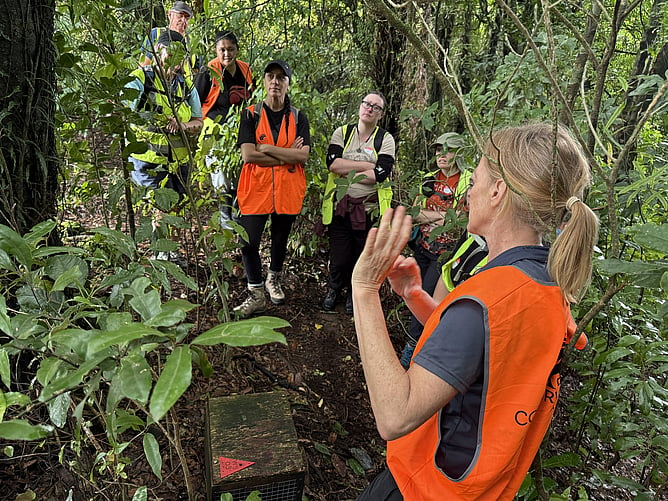
A key focus since September has been the development of Tauira Mahi Conservation Training, BCA’s revised training programme designed to strengthen knowledge and capability across the community conservation sector.
The programme offers a mix of online and in-person field-based learning. Online training units will cover practical topics including native plant identification, identifying New Zealand birds, introduction to freshwater environments, New Zealand bird monitoring and conservation project management.
The field-based units provide hands-on learning and include foundations in conservation, freshwater conservation, identifying New Zealand birds and introduction to pest animal control. These units are capped at 12 people per teaching day to support quality learning.
Michelle says the programme has been developed to support people committed to protecting Aotearoa’s taonga species and critical ecosystems.
“Many community conservation groups are volunteer-led and are looking to upskill existing or new volunteers. Tauira Mahi has been designed to be low-cost and accessible, helping increase knowledge and capability across volunteers, iwi projects, or to assist those seeking a career path in conservation,” says Michelle.
The in-person Tauira Mahi training units were piloted throughout March and April, with the full programme including online training units opening to participants from July 2026. Find out more at: www.training.bayconservation.nz/
This funding benefits the Western Bay community directly through healthier waterways, restored wetlands and forests, protected native species, and opportunities for locals to get involved as volunteers and kaitiaki.
By supporting Bay Conservation Alliance as a lead body and backing the grassroots groups it supports, TECT is helping ensure conservation work in the Western Bay is not only passionate but also well-supported, well-coordinated, and sustainable for the long term.
For more information see www.bayconservation.nz and www.tect.org.nz
To learn about Conservation Week (April 20-26) see www.doc.govt.nz